Stuck at the Same Weight for Weeks? The Effort Fix for Plateaus
Stuck at the same weight for weeks? The most common cause is under-effort, not programming. Check whether your reps actually slow down before you overhaul anything.
 Riven · Training
Before you rip up your program, check the cheaper fix: you're probably not training as hard as you think. The most common silent cause of a strength plateau isn't bad programming, low volume, or a missing deload — it's that your working sets feel hard but stop several reps short of where growth and strength adaptations actually happen. Diagnose effort first. If your sets genuinely reach the near-failure zone and you're still stuck, then touch load, volume, or recovery — in that order.
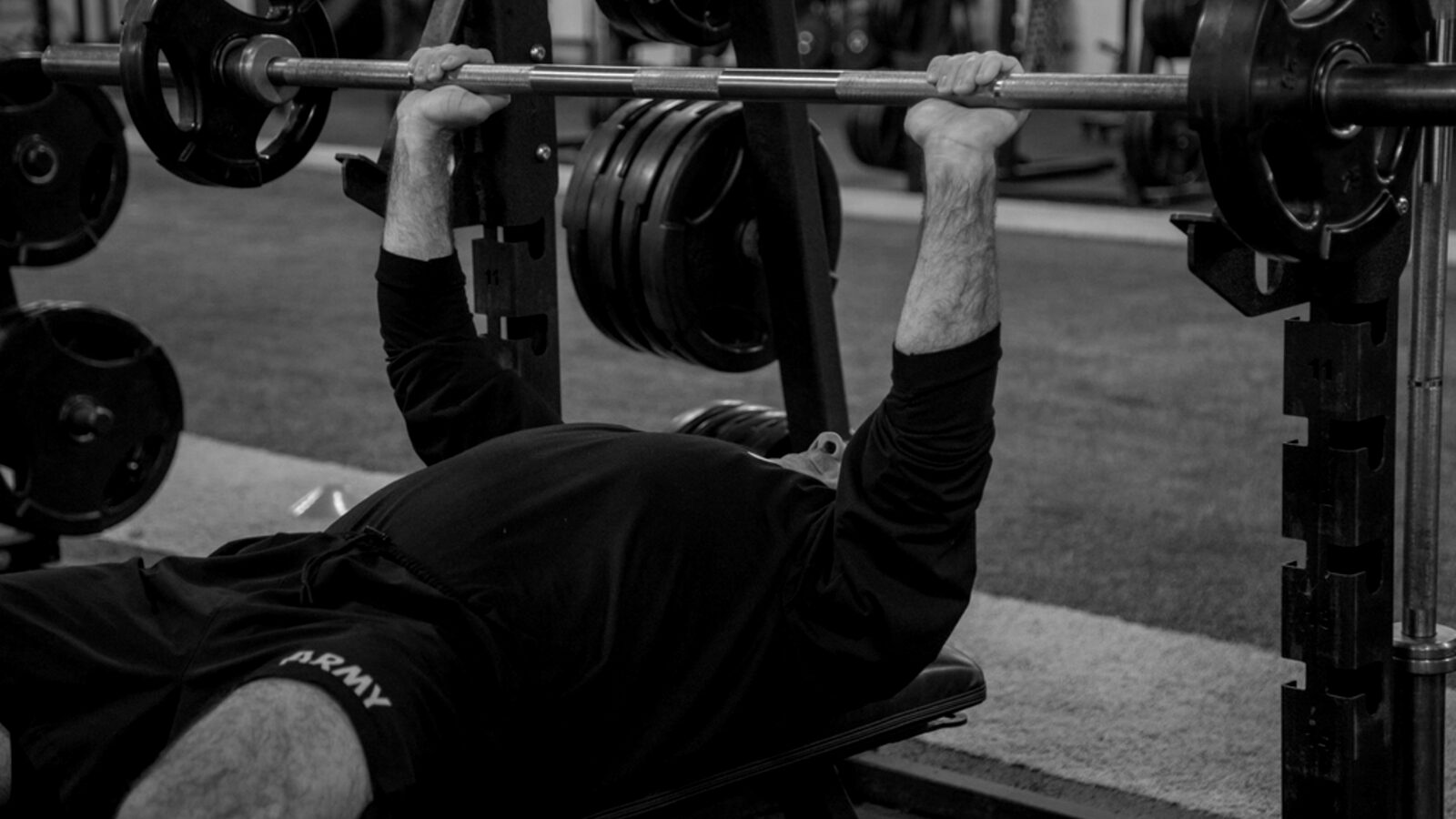
Here's the gym moment I see constantly. A lifter "stuck at 100 kg for six weeks" is about to switch to a new split. Then I watch the set: the bar moves at the same speed on rep one and rep eight. No grind, no slowdown. They racked it with three or four reps still in the tank — and have no idea, because it felt like a max effort. That's not a programming problem. That's an effort problem wearing a programming costume.
Is it a real plateau or am I just not training hard enough?
Most "plateaus" are an effort problem before they're a programming problem, so diagnose effort first. A true plateau means your stimulus is adequate and your body has stopped responding. An under-effort plateau means the stimulus was never there — you've been doing comfortable sets that look hard on paper.
This is easy to miss because your internal effort gauge is systematically wrong in one direction: you stop too early. In a study of resistance-trained lifters, when people were told to stop where they thought they had exactly one rep left, they actually had around 2 to 3 reps still in reserve — quitting at a self-rated max of about 11.6 reps when they could really hit 14.3. And the further you stop from failure, the less your guess can be trusted: prediction is reasonably calibrated within a rep or two of true failure and gets shakier further out. So the lifter sitting at 4 or 5 reps in reserve — exactly the plateau zone — is the one whose guess is least trustworthy.
This is why "train harder" sounds like useless advice but is usually correct. You can't decide to feel effort more accurately; you need a way to check it.
What does the under-effort plateau actually look like?
It looks like consistency without progression: you show up, finish your sets, the weights never go up, and nothing hurts the next day. The tell is that the last rep looks identical to the first.
Muscle growth is driven by mechanical tension applied close to failure. A 2024 meta-regression found that changes in muscle size increase as sets are taken closer to failure — the closer you stop to the wall, the more you grow. Strength is more forgiving (that same analysis found a negligible relationship between stopping point and strength gain), but it still needs enough proximity to recruit and fatigue your high-threshold motor units. Parked at 4 or 5 reps in reserve every set, you under-recruit the very fibers that drive adaptation, and no amount of consistency rescues a stimulus that isn't there.
The cruel part is that under-effort sets feel productive — you're uncomfortable and sweating. But discomfort and proximity-to-failure aren't the same thing, which is the whole point of training to failure versus just getting tired. Tired is a feeling; failure is a mechanical event — the rep you physically cannot complete with full range of motion. Most plateaued lifters confuse the two.
How do I check whether my reps actually slow down within the set?
Watch — or better, measure — how much your reps slow down from the first to the last. If your last rep moves at nearly the same speed as your first, you stopped well short of failure. Real proximity shows up as an involuntary slowdown you cannot override no matter how hard you try.
This isn't a feel thing; it's physics. As a muscle fatigues, its force output drops and the bar (or your limb) physically moves slower on each rep — the single most reliable, measurable signal of how close you are to failure. The research puts rough numbers on it: in one training study, the loss of lifting velocity from the first to the final set was about 22% when sets were taken to failure, versus roughly 9% at one rep in reserve and only about 6% at three reps in reserve. The pattern is what matters: more proximity to failure, more slowdown. If your reps are barely fading, you're nowhere near the zone, no matter how the set felt.
Here's a self-test you can run this week, no equipment required, using just your eyes and a phone on a tripod:
- Pick one main lift and a weight you'd normally call "hard."
- Film your working set from the side and stop where you'd normally stop.
- Watch the footage and compare the speed of your first rep to your last.
- If the last rep is visibly slower — a clear grind, range of motion shrinking, a real fight — you're training in the right zone.
- If the last rep looks as crisp as the first, you stopped too early. Next session, do two or three more reps on that same weight and feel what real proximity to failure is.
Most people who run this test once are surprised. The rep they thought was their last had two more behind it.
What does velocity loss tell me, and where should I stop?
Velocity loss is a proxy for both fatigue and proximity to failure, and the right amount depends on your goal: lower thresholds suit strength and power, higher ones drive hypertrophy. Here's the rough map the literature supports — direction, not gospel, since the relationship shifts by exercise, load, and set number.
| Goal | Approx. velocity loss to stop a set | Roughly how far from failure |
|---|---|---|
| Strength / power | ~10–20% | 3+ reps in reserve |
| Hypertrophy (balanced) | ~20–25% | 1–2 reps in reserve |
| Training to / near failure | ~25–40%+ | 0–1 reps in reserve |
One useful caveat: a systematic review by Refalo and colleagues found hypertrophy gains appear to plateau around the 20–25% velocity-loss range — going from a moderate (20–25%) to a high (>25%) loss showed no statistically significant added benefit (effect sizes 0.39 vs 0.42; difference p=0.529). The message isn't "grind every set into the floor." It's that there's a floor of effort you have to clear, and the plateaued lifter is almost always under it, not over it. For where these cutoffs come from, see velocity loss thresholds explained.
What if my effort really is maxed out? Overload, volume, deload
If you've honestly verified that your sets reach the near-failure zone and you're still stuck, then it's a true plateau — and now the programming levers actually matter. Work them in this order: progressive overload, then volume, then a deload.
Progressive overload first. Hypertrophy and strength both need the stimulus to climb over time; if the tension never increases, the signal stays flat and so do you. And you don't only have load to work with — adding a rep at the same weight, a small plate, or a quality set progresses you just as well as chasing a heavier bar. The classic mistake is program-hopping: swapping routines every three weeks resets the clock and keeps you stuck in the low-return early phase forever. Pick a progression and run it long enough to actually overload something. (For a smarter add-weight trigger than the old 2-for-2 rule, see when to add weight.)
Volume second. More hard sets per muscle per week can restart progress — but only if the new sets are genuinely hard. Adding volume on top of under-effort sets just adds junk; twenty-five easy sets can stimulate less than twelve real ones. If you haven't fixed effort, "do more sets" makes the problem bigger, not smaller.
Deload last. Sometimes the plateau is accumulated fatigue masking your real strength — you're not weak, you're buried. An international expert consensus on deloading found coaches typically deload every 4–6 weeks for about 7 days, usually by cutting training volume (fewer reps per set, fewer sets, or both) while keeping intensity reasonably high, triggered either on a planned schedule or reactively when performance stalls. A lift that suddenly moves again after a lighter week was a fatigue problem, not a stimulus problem.
The order matters because these levers fail differently with bad effort: add load and you just miss reps, add volume and you dig a recovery hole, deload and you come back to plateau at the exact same spot.
Can an Apple Watch tell me whether I'm actually training hard enough?
It can give you an objective second opinion on the one cue you can't see — and that beats guessing, which is what almost everyone does. This is exactly the blind spot Riven is built for. Using only the Apple Watch's motion sensors and heart rate — no camera, no barbell clip, no extra hardware — it measures how much your reps slow down across a set and turns that velocity decay into a 0–100 failure-proximity score, per muscle group, in real time. Where you have a gut feeling that's reliably wrong by 2 to 3 reps, you get a number.
The honest caveats matter. The wrist is a proxy, not a lab instrument: it reads roughly half the velocity-loss magnitude of a $300-plus barbell linear position transducer at the same physiological fatigue, so it's a direction-finder, not a precision gauge. And velocity is complementary to feel, not a universal cutoff — across nearly 3,000 measurements, bar velocity explained only about 30% of perceived reps-in-reserve variance. Heart rate is supporting context only. But you're not competing against a lab — you're competing against a guess that undershoots by several reps every set, and an honest proxy that catches "you stopped three reps early" beats a perfect number you never had. For the broader picture, here are the objective signs you're training hard enough.
The two-week test to find your real bottleneck
Spend two weeks isolating the effort variable before you touch anything else. Week one, train exactly as you have been but film your top working set on two main lifts — a crisp, fast last rep points to effort as your bottleneck; a visible grind says your effort is fine and the problem is programming. Week two, on those same lifts and weights, push every set 2–3 reps further with strict form and full range of motion. If the weights suddenly feel like a fight, your plateau was an effort problem and you've fixed it for free. If the effort was already there, you've confirmed a real plateau — so apply one programming change at a time (overload, then volume, then deload) and give each 3–4 weeks before judging it.
No new program, no new equipment. The whole point is to stop guessing about the one thing you can't feel — because guessing is what built the plateau in the first place.
FAQ
How do I know if I'm plateauing because I'm not training hard enough?
Film your top working set and compare your last rep to your first. If the last rep moves nearly as fast as the first, with no grind and full range of motion intact, you stopped well short of failure — that's an under-effort plateau. Trained lifters typically have 2 to 3 reps still in reserve when they think they're done, so this is the default suspect before you change your program.
Should I add weight, add sets, or deload to break a plateau?
In that order, but only after you've confirmed your effort is genuinely high. Progressive overload (more load or more reps) is the first lever. If you're already overloading and stalled, add volume — but only hard sets, since easy ones just add fatigue. Deload last, when the issue is fatigue masking your strength rather than a missing stimulus.
How much should my reps slow down by the end of a hard set?
Roughly, a velocity loss around 20–25% lines up with stopping 1–2 reps shy of failure, while ~25% or more reflects training to or very near failure. If your reps barely slow, you're nowhere near the failure zone regardless of how the set felt.
Can an Apple Watch measure my training effort?
Yes, indirectly. Apps like Riven read the rep-speed slowdown across your set from the watch's motion sensors and turn it into a failure-proximity score per muscle group. The honest limit: the wrist reads about half the velocity loss of a dedicated barbell tracker, and velocity only explains about 30% of perceived effort — so treat it as an objective second opinion that beats a gut feeling, not a lab-grade number.
Do I have to train to absolute failure to break a plateau?
No. Stopping 1 to 3 reps from failure captures nearly all of the strength and hypertrophy stimulus with far less junk fatigue. Most stuck lifters have the opposite problem of grinding too hard — they're 4 to 5 reps short of failure and don't realize it. Close that gap first.
Sources
- Halperin, Steele et al. (2021), "Just One More Rep!" — Ability to Predict Proximity to Task Failure in Resistance Trained Persons, PMC — https://pmc.ncbi.nlm.nih.gov/articles/PMC7785525/
- Jukic et al. (2025), Exercise type, training load, velocity loss threshold, and sets affect the relationship between lifting velocity and perceived repetitions in reserve in strength-trained individuals, PMC — https://pmc.ncbi.nlm.nih.gov/articles/PMC12360324/
- Robinson, Pelland et al. (2024), Exploring the Dose-Response Relationship Between Estimated Resistance Training Proximity to Failure, Strength Gain, and Muscle Hypertrophy: A Series of Meta-Regressions, SportRxiv — https://sportrxiv.org/index.php/server/preprint/view/295
- Refalo et al. (2023), Influence of Resistance Training Proximity-to-Failure on Skeletal Muscle Hypertrophy: A Systematic Review with Meta-analysis, PMC — https://pmc.ncbi.nlm.nih.gov/articles/PMC9935748/
- Refalo, Helms et al. (2023), Influence of Resistance Training Proximity-to-Failure, Determined by Repetitions-in-Reserve, on Neuromuscular Fatigue in Resistance-Trained Males and Females, PMC — https://pmc.ncbi.nlm.nih.gov/articles/PMC9908800/
- Bell / Coppock et al. (2023), Integrating Deloading into Strength and Physique Sports Training Programmes: An International Delphi Consensus Approach, PMC — https://pmc.ncbi.nlm.nih.gov/articles/PMC10511399/